Dating Safety Signals Report · 2026 edition
What dating platforms tell you to watch for.
A cross-platform look at the safety advice published by dating and matchmaking services, what their safety signals can show, and where the advice stops.
The short answer
A safety signal can justify slowing down without proving who someone is.
This report is not a scammer database, a background-check service, or a scorecard for dating apps. It compares public safety guidance so readers can see the repeated boundaries, the useful differences, and the limits that are easy to miss.
Four findings from the first edition
The useful pattern is in the overlap and the gaps.
The strongest convergence
The same few boundaries appear across very different products.
Do not rush, keep control of personal and financial information, tell someone before meeting, and use block/report tools when a boundary is crossed. This is a convergence of public guidance, not proof that every platform performs equally well.
The important limit
Verification is a narrow signal, not a safety verdict.
Photo, selfie, ID, phone, or video checks can answer a limited question about a moment or a submitted signal. They cannot establish honesty, income, relationship status, intentions, or future conduct.
The useful gap
Most public advice says “too soon” without defining a clock.
The sources warn about quick off-app moves and urgent requests, but they rarely provide a universal number of hours or days. A good guide should teach readers to look at timing, pressure, and the request together instead of inventing a deadline.
The regional difference
Safety is not only about romance scams.
LGBTQ+ travel and location risk, image-based abuse, community privacy, family and marriage expectations, and local support access can change what a “safer next step” means.
Citation snapshot
Four findings editors can quote with the limits intact.
- Public safety guidance converges on a few boundaries: slow down, keep control of personal and financial information, plan first meetings independently, and use reporting tools when a boundary is crossed.
- Verification is narrow: a photo, selfie, ID, phone, or video check can answer one limited question; it does not establish honesty, income, intentions, or future behaviour.
- Timing matters more than an invented clock: sources warn about quick off-app moves and urgent requests, but do not support one universal number of hours or days before trust.
- Context changes the next step: LGBTQ+ privacy, image-based abuse, marriage and family expectations, and local support access can create risks that a generic romance-scam list misses.
RealAttraction Research, Dating Safety Signals Report 2026, public-source snapshot 22 July 2026, updated 24 July 2026.
Copy the full citation wordingFrom chat to a harder-to-undo decision
A common risk path is a sequence, not a label.
The sequence below is a synthesis of recurring platform guidance and independent public sources. It is a teaching model, not a prediction about any particular person.
A profile creates a fast sense of trust
A polished profile, badge, shared interest, or live call may answer one narrow question. It does not settle identity, honesty, intent, or future behaviour.
The conversation moves away from the app
Platforms repeatedly tell users to notice pressure to move quickly to text, email, a phone number, WhatsApp, Telegram, or another service where the platform has less visibility.
A private, financial, or urgent request appears
The request may involve a private image, identity document, account detail, money, gift card, crypto, investment, travel cost, or emergency story.
Pressure makes a reversible choice feel urgent
The useful safety question is not “Can we prove this person is a scammer?” It is “What can I delay, refuse, or keep private while I think?”
A meeting or a problem leaves the digital space
A public place, independent transport, a charged phone, a trusted person, and an easy way to leave are recurring meeting-safety themes. If something already happened, use the platform, bank, emergency, or official support route that fits.
For reported romance-scam patterns involving off-platform messaging, money, cryptocurrency, gift cards, and sextortion, see the FTC data spotlight. Complaint data describes reports received by an agency; it is not a count of every interaction or every victim.
Research evidence
What research adds beyond platform advice.
Public platform guidance tells users what to do. Academic and university research helps explain mechanisms, affected populations, and design limits. It is used here to sharpen education, not to label or score a person.
Digital dating violence, pressured sexting, and image-based abuse
Joris Van Ouytsel and collaborators
It helps explain why a private-image request is a safety decision involving pressure, consent, privacy, and possible later harm, not merely a question of whether a profile looks real.
Limit: These studies do not provide an all-age prevalence estimate or a person-level detector. A pressured request is a reason to pause, not proof of criminal intent.
ASU faculty profile and publication recordConsent and AI-generated self-presentation in online dating
Douglas Zytko and collaborators
It puts disclosure and informed consent on the safety map: polished language or a fast emotional connection may be shaped by a tool, and that possibility cannot be settled by a verification badge.
Limit: The study does not show that AI use causes harm, that undisclosed AI use is always deceptive, or that a particular person used AI.
CHI 2026 paper: AI-generated self-presentation on dating appsDating-app design, safety policy, marginalized users, and surveillance
Christopher Dietzel, Stefanie Duguay, Diana Parry, and collaborators
It prevents a common mistake: treating safety as only the user’s responsibility. A feature can help in one moment while also creating privacy, policing, or exclusion concerns for another user.
Limit: This is not an app ranking, an incident-rate comparison, or proof that every platform feature has the same effect in every community.
Individualized responsibility, policing, and surveillanceMapping safety, risk, and support across dating-app use
Diana Parry and collaborators
It offers a useful information architecture: safety is a route through several moments and support options, not a single badge or a final verdict.
Limit: The existence of a map or guide is not an outcome evaluation. It does not prove that a user will be safe or that one route fits every location.
Swipe right, safer: the Dating App Safety MapRelationship development and movement between online and offline settings
Liesel Sharabi and collaborators
It helps describe the transition from app chat to another channel or an in-person meeting as a change in context, not as an automatic sign of danger.
Limit: This is not a romance-scam prevalence study and does not establish a universal safe timeline for moving off-app or meeting.
ASU Relationships and Technology Lab profileAI-enabled romance scams and support for older adults
Sanchari Das and Ruba Abu-Salma with collaborators
It keeps emerging AI-enabled manipulation and family or community support in view without treating an older person’s age as a diagnosis of vulnerability.
Limit: This announcement is not a completed peer-reviewed finding. It must not be used to claim that older adults are uniformly more likely to be deceived.
George Mason University award announcementWhat the selected platform sources mention
The advice converges, but the emphasis changes.
Share of the eight reviewed official platform sources that explicitly address each topic in the captured public material. This is guidance coverage, not a safety score, incident rate, or product ranking.
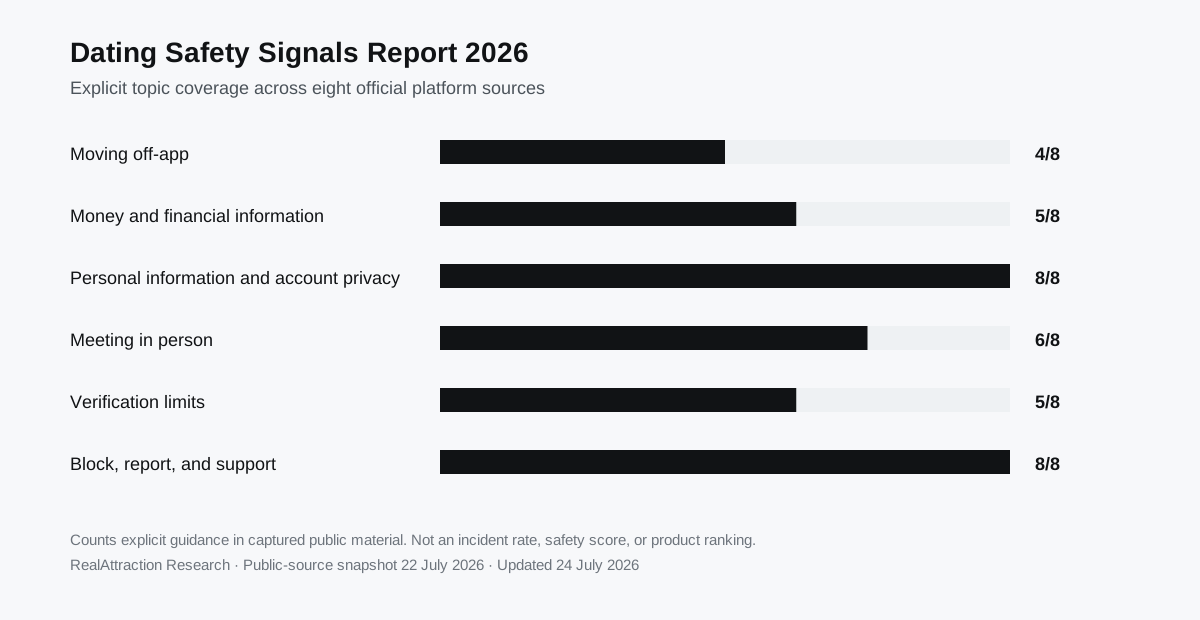
Coding rule: an item counts when the official source gives direct guidance or describes a related safety feature. A blank topic is not evidence that a platform has no such policy.
| Topic | What it captures | What it does not capture |
|---|---|---|
| Moving off-app | Warnings about fast moves to text, phone, WhatsApp, Telegram, email, or another service. | A universal safe number of hours or days. |
| Verification limits | Statements about photo, selfie, ID, phone, video, or related checks. | Proof that a person is honest, safe, or who they claim to be. |
| Report and support | Block, unmatch, report, safety center, helpline, or emergency-resource guidance. | A guarantee that a report will lead to a particular outcome. |
Read the signal, not the label
What common checks may show, and what they cannot show.
Photo or selfie verification
May show: a submitted image matched a platform’s limited check.
Cannot show: a real name, income, relationship status, honest story, or future behaviour.
ID verification
May show: a document and a person were checked under a platform process.
Cannot show: that every profile detail is current, or that the person will respect a boundary.
Live video call
May show: someone appeared live at that moment.
Cannot show: that their story, request, location, or intentions are true.
Respect for “no”
May show: how someone responds when you slow down or set a boundary.
Cannot show: a guarantee that future pressure or harm will not occur.
Different communities, different exposure
A useful guide cannot treat every dating context as interchangeable.
Broad dating
Off-app moves, money requests, personal information, verification limits, and first-meeting planning are recurring themes.
LGBTQ+ dating
Location exposure, outing risk, hostile legal environments, travel, privacy, and device security can change the safest next step.
Marriage-focused dating
Identity, family expectations, financial help, serious-intent claims, and community privacy need their own language.
Image and privacy risk
Private images, account access, blackmail, and unwanted sharing require a different response from ordinary profile uncertainty.
The independent context for these differences includes eSafety’s online dating guidance and Ofcom’s dating and social discovery risk guidance.
The first source set
Eight official platform sources, kept in context.
The library records what each source says, not whether the platform’s safety program works. Features and help pages change, so every entry carries a last-checked date and a direct source link.
Mainstream · Global
Tinder
Combines user guidance with Share My Date, Photo Verification, Face Check, reporting, and travel-related safety notes.
Tinder Safety Tips · Last checked 22 July 2026. Current public page; feature availability varies by market.
Mainstream · Global
Bumble
Highlights photo and ID verification, voice and video calls, Private Detector, Deception Detector, Share Date, and reporting.
Bumble Safety Center · Last checked 22 July 2026. Current public page; feature availability varies by market.
Relationship-focused · Global
Hinge
Explicitly warns about quick moves to other messaging services, money requests, meeting plans, consent, and the limits of risk reduction.
Safe Dating Advice · Last checked 22 July 2026. Updated 12 February 2026.
Relationship-focused · Global
Match
Covers money and crypto, long-distance stories, staying on-platform, first meetings, consent, account protection, and LGBTQ+ travel risks.
Dating Safety Tips · Last checked 22 July 2026. Current help-center page.
Relationship-focused · Global
Coffee Meets Bagel
Uses plain warnings about finance and personal information, while stating that no system is perfect and describing first-meeting precautions.
Dating Safety Tips · Last checked 22 July 2026. Updated 25 February 2026.
Niche · Global
Grindr
Adds a privacy and security lens that is especially relevant to location exposure, outing risk, device security, and hostile environments.
Holistic Security Guide · Last checked 22 July 2026. Public guide; publication date shown in source PDF.
Niche · Global
Muzz
Pairs safety guidelines with region-sensitive support resources, including helplines and services relevant to its community.
Muzz Safety Center · Last checked 22 July 2026. Current public page; local resources vary by region.
Niche · India and global diaspora
Shaadi.com
Brings marriage-focused identity, family, financial-help, public-meeting, and report-misuse questions into the comparison.
Privacy and Safety Tips · Last checked 22 July 2026. Current public page.
Method, scope, and limits
How this report was put together.
- Selected a representative first set. The first edition covers eight products across mainstream, relationship-focused, LGBTQ+, Muslim matchmaking, and South Asian matrimony contexts. It is not a claim to cover every dating product.
- Used official platform material for platform claims. Safety centers, help pages, and public guides are the source for a feature or recommendation attributed to a platform.
- Used independent sources for broader risk context. Government and regulator material helps explain complaint patterns and system-level risks; it is not blended into platform marketing claims.
- Added a separate academic evidence layer. Research is used to explain mechanisms, populations, and design limits. It is not converted into an individual risk score, identity claim, or investigation.
- Coded topics, not outcomes. The chart counts whether a topic appears in the captured source. It does not measure how often harm occurs, how quickly reports are handled, or which product is safer.
- Recorded the snapshot date. Public pages change. A last-checked date is part of the citation, and corrections or changed links should be sent to hello@realattraction.today.
Independent sources
Sources used for context.
Romance scammers’ favorite lies exposed
U.S. Federal Trade Commission · Last checked 22 July 2026.
Reported patterns involving social media, off-platform messaging, money, cryptocurrency, gift cards, and sextortion. These are complaint data, not a census of all incidents.
Online dating safety guidance
eSafety Commissioner · Last checked 22 July 2026.
Independent public guidance on privacy, abuse, coercive control, image-based abuse, app features, and the voluntary online dating code.
Dating and social discovery: online safety risks
Ofcom · Last checked 22 July 2026.
A regulator perspective on risks for dating and social-discovery services, separate from any individual platform’s marketing or help copy.
See the academic evidence library for the research sources, populations, evidence types, and limits used in this edition.
For editors, educators, and researchers
Need a short quote or a chart?
Use the stable report URL, name the edition date, and link to the underlying source. The one-page summary, chart, data file, and media page are designed for direct citation.
Open the one-page summary Open Press & Media